

Introduction
If you’ve ever thought about investing in real estate but didn’t want the headaches of buying, managing, or renting a property, hard money lending investing might catch your attention. At its core, it’s about becoming the lender instead of the owner. You provide short-term loans to real estate investors-often those flipping homes or developing properties-and earn interest in return. The key difference? The loan is secured by the property itself, not the borrower’s credit score.
Why does it matter for investors? Because it offers a way to earn potentially higher returns than traditional investments like savings accounts or bonds, while keeping your capital backed by a tangible asset. You’re not betting on the stock market or hoping for long-term property appreciation-you’re betting on the deal and the collateral.
Unlike traditional bank loans, which can take weeks or months to approve and require strict credit checks, hard money loans focus on the value of the property and the borrower’s plan. Banks prioritize paperwork and credit history; hard money lenders prioritize speed, opportunity, and risk management. This flexibility makes hard money lending appealing for both investors and borrowers looking for quick financing.
In short, hard money lending investing is a bridge between traditional lending and direct property investment-offering control, speed, and real-world returns for those willing to do the homework.
Table of Contents
How Hard Money Loans Work
Hard money loans are straightforward in concept, but the details make all the difference. Essentially, you’re lending money to a real estate investor for a short-term project, and the property itself serves as collateral. This means if the borrower can’t repay, you have a claim on the property-a safety net that traditional unsecured investments don’t offer.
The Loan Process
Application & Deal Evaluation – The borrower presents the property and their plan. Unlike banks, you focus on numbers and property value, not just credit history.
- Loan Approval – You or your lending group decide on loan terms, typically using a conservative loan-to-value (LTV) ratio to protect your investment.
- Funding – Once approved, funds are released quickly-sometimes in days rather than weeks.
- Repayment – The borrower pays back the loan plus interest, often when the property is sold or refinanced.
Interest and Terms
Hard money loans usually carry higher interest rates than conventional mortgages-often in the high single digits or low double digits-because they’re short-term and carry more risk. Loan terms typically range from 6 to 12 months, making them ideal for quick projects rather than long-term holdings.
Example: A Fix-and-Flip Deal
Imagine Jane, a real estate investor, finds a house she can buy for $150,000 and renovate for $50,000. She expects to sell it for $250,000. Traditional banks might hesitate because of tight timelines and her credit history.
As a hard money lender, you provide a $160,000 loan covering the purchase and part of the renovation. The property secures the loan. Jane completes the renovations in six months and sells the house. You receive your principal plus agreed-upon interest-often 8–10% for the short loan period. Your investment was short-term, asset-backed, and potentially more profitable than traditional alternatives.
May be you like it:
How Long Does It Take to Learn Day Trading Effectively?
Boost Your Career with an Online Accounting Diploma
Smart Strategies for Generational Wealth Management
What Is a Smart Investment – Simple Guide for Beginners
Why Investors Choose Hard Money Lending
Many investors are drawn to hard money lending investing because it offers a combination of speed, control, and returns that’s hard to find elsewhere. Unlike traditional investments, it gives you both tangible security and flexibility.
Short-Term Returns
One of the biggest advantages is the short investment cycle. Most hard money loans last anywhere from six to twelve months. That means your money isn’t tied up for years like it would be in long-term real estate or retirement accounts. For investors who like seeing results quickly, this can be very appealing. It also allows you to recycle your capital into multiple deals within a year.
Tangible Asset Backing
Hard money loans are backed by real property, not just a borrower’s credit history. This makes it feel more concrete-if the borrower defaults, the property serves as collateral. Unlike stocks or bonds, which exist mostly as numbers on a screen, your investment is tied to a physical asset you can assess and inspect.
Flexibility
Hard money lending offers flexibility that many other investments lack. You can choose the types of deals, the loan terms, and even the level of involvement you want. Whether you prefer fully passive lending or taking a more hands-on approach by evaluating deals yourself, there’s room to tailor the experience.
How It Compares to Other Investments
- Savings Accounts / Bonds: Low risk, but low returns and long timelines.
- Stocks / ETFs: Potentially higher returns, but exposed to market volatility.
- Direct Real Estate Ownership: High control and tangible assets, but involves management, repairs, and long-term commitment.
- Hard Money Lending: Moderate-to-high returns, short-term investment, tangible security, and minimal operational involvement.
In short, hard money lending bridges the gap between traditional investing and real estate ownership. It gives investors the chance to earn solid returns without the headaches of property management-as long as they understand the risks and structure their deals carefully.
Benefits of Hard Money Lending Investing
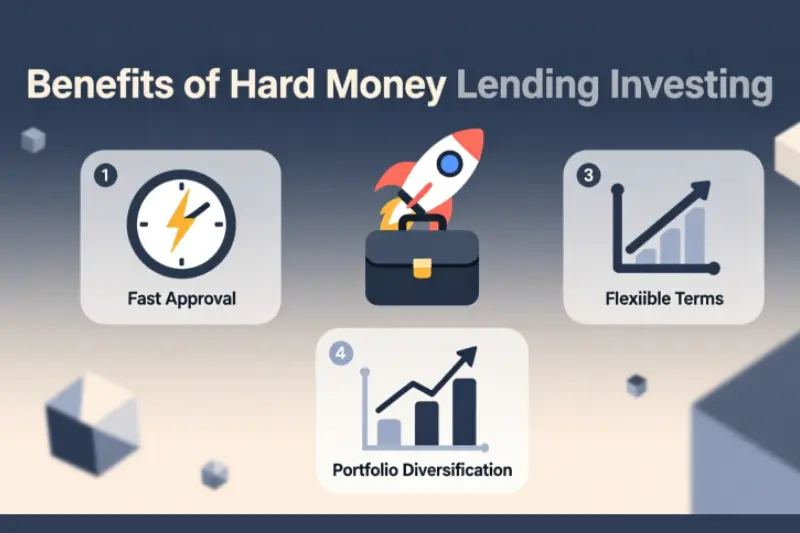
If you’re weighing whether to dive into hard money lending investing, it helps to understand the key benefits that make it appealing to investors-especially beginners looking for tangible results.
Faster Returns
Unlike traditional real estate investments, which can take years to pay off, hard money loans usually last 6 to 12 months. That means you can see returns quickly and even reinvest your money multiple times a year. For investors who value liquidity and faster feedback on their decisions, this short-term cycle is a major plus.
Higher Interest Rates
Hard money loans carry higher interest rates than conventional mortgages, often in the high single digits or low double digits. This compensates for the short-term risk and flexibility you’re providing. For many investors, that’s a significant improvement over low-yield savings accounts, CDs, or even some bonds.
Less Credit Dependency
Traditional banks heavily rely on the borrower’s credit score and financial history. Hard money lending focuses more on the property and the deal itself. This reduces the emphasis on borrower credit while giving you security through collateral. In other words, even if the borrower’s credit isn’t perfect, your investment can still be relatively protected.
Real Estate-Backed Security
Every hard money loan is tied to real property, meaning your investment isn’t just a number on a balance sheet. If the borrower fails to repay, the property serves as collateral, providing a level of protection most other investment options don’t offer. This tangible security allows investors to manage risk more effectively.
Risk Mitigation
With careful due diligence-like evaluating the property value, the borrower’s plan, and loan-to-value ratios-investors can minimize potential losses while still enjoying the benefits of higher returns. In many ways, the structure of hard money lending allows you to be both opportunistic and cautious at the same time.
Risks and Challenges of Hard Money Lending
While hard money lending investing can offer attractive returns, it’s not without risks. Understanding these challenges is essential-especially for beginners-so you can protect your capital and make informed decisions.
Borrower Default
One of the most obvious risks is borrower default. Even experienced real estate investors can run into problems: renovations can go over budget, unexpected repairs may appear, or market conditions can slow a sale. If the borrower can’t repay on time, you could be forced to take control of the property or wait longer than expected to get your principal back.
Example:
A borrower planning to flip a house underestimated roofing repairs. Costs doubled, delaying the sale by three months. The lender had to wait for repayment, reducing their planned return and temporarily tying up their capital.
Property Value Miscalculations
Hard money loans are secured by property, which seems safe-but overestimating a property’s after-repair value (ARV) can be dangerous. If the property sells for less than expected, or the renovation costs are higher than planned, your collateral might not cover the loan entirely.
Example:
An investor bought a property thinking it would sell for $220,000 after renovations. Unexpected foundation issues increased repair costs, and it only sold for $200,000. The lender had to absorb a portion of the loss because the loan exceeded the final value.
Liquidity Issues
Unlike stocks or bonds, your money in a hard money loan isn’t easily accessible until the borrower repays or sells the property. This lack of liquidity can be a problem if unexpected expenses arise or you need cash quickly.
Example:
A lender funded two loans simultaneously, then faced an emergency requiring immediate cash. Both loans were tied up for 6–12 months, leaving them scrambling for funds.
Managing Risks
These risks don’t mean hard money lending is unsafe-they just require vigilance. Experienced lenders mitigate risk by:
- Setting conservative loan-to-value ratios
- Thoroughly vetting borrowers and their experience
- Choosing deals with realistic timelines and budgets
- Using legal protections like contracts and title insurance
By understanding these challenges upfront, beginners can enter hard money lending with realistic expectations and a plan to protect their investment.
May be you like it:
Free Trading Webinar: Learn Smart Market Strategies
Certificate in Business Management Online: Your Career Boost
Smart Generational Wealth Planning for Lasting Legacy
Top Personal Investment Company Tips for Smart Investors
How to Evaluate a Hard Money Loan Deal
Evaluating a hard money loan isn’t about gut feelings or trusting the borrower’s story. It’s about numbers, property value, and exit strategy. For beginners, this step is crucial-your money is only as safe as the deal itself.
Loan-to-Value (LTV) Ratio
The loan-to-value ratio compares the loan amount to the property’s value. A lower LTV means more security for the lender. For example, if a property is worth $200,000 and you lend $150,000, the LTV is 75%. Experienced lenders often aim for 70–75% LTV to allow a buffer if the property doesn’t sell for the expected price.
Property Condition
Not all properties are created equal. Inspecting the property or reviewing detailed repair estimates helps you understand potential hidden costs. Even small oversights-like outdated wiring or water damage-can significantly impact the final sale price and your repayment.
Example:
A lender approved a loan on a fixer-upper without reviewing the plumbing. Midway through the renovation, extensive plumbing work doubled costs, delaying repayment. Proper evaluation could have prevented this.
Exit Strategy
Every borrower should have a clear exit strategy-how and when they plan to repay the loan. Common strategies include:
- Selling the property after renovation
- Refinancing the loan with a traditional mortgage
- Using rental income to cover repayment
As a lender, ask yourself: Does this strategy seem realistic? Are there contingencies if the plan changes?
Importance of Due Diligence
Due diligence isn’t optional; it’s your insurance. Review:
- Borrower experience and past performance
- Market comparables to confirm ARV (after-repair value)
- Detailed budgets and renovation timelines
Numbers don’t lie. If the math doesn’t make sense, it’s better to pass on a deal than risk your capital. Remember, in hard money lending, patience and careful evaluation often beat speed and excitement.
Getting Started as a Beginner
If you’re new to hard money lending investing, the best advice is simple: start small and learn as you go. Jumping in with a large loan on your first deal is tempting, but it can lead to unnecessary risk. Starting conservatively helps you build confidence and experience without putting your capital in danger.
Start with Small Investments
You don’t need to fund an entire loan on your own. Many beginners begin by:
- Partnering with experienced lenders on deals
- Investing through private lending firms that pool capital
- Participating in fractional loans to spread risk
Small investments allow you to see how the process works, understand borrower behavior, and evaluate outcomes before committing more money.
Work with Experienced Professionals
Even a small loan benefits from expert guidance. Attorneys, title companies, and seasoned lenders provide a safety net and help you avoid rookie mistakes. Their experience can highlight hidden risks, suggest better loan structures, and ensure your legal protections are in place.
Step-by-Step Approach for First-Time Investors
- Educate Yourself – Read about hard money lending, terminology, and market trends. Knowledge is your first defense.
- Identify Reliable Borrowers – Look for investors with a proven track record and a clear plan.
- Evaluate the Deal – Review LTV, property condition, and exit strategy carefully.
- Start Small – Fund a portion of the loan or join a lending group.
- Monitor the Loan – Stay informed about progress, timelines, and market conditions.
- Learn from Each Deal – Reflect on what went well and what could improve for the next investment.
Starting conservatively doesn’t mean small returns-it means safer, smarter growth. By building experience gradually, you’ll be better prepared to take on larger loans and maximize your hard money lending opportunities.
Legal and Professional Considerations

One of the biggest mistakes beginners make in hard money lending investing is underestimating the legal side. Skipping proper contracts or title checks might seem like a shortcut, but it can cost you far more than any potential return.
Contracts Are Your Foundation
Every hard money loan should have a clear, legally binding contract. It outlines:
- Loan amount and interest rate
- Repayment schedule
- Collateral details
- Remedies in case of default
A well-drafted contract protects both you and the borrower, preventing misunderstandings and giving you legal leverage if things go sideways.
Title Insurance Protects Your Investment
Even if the borrower defaults, the property itself may have existing liens or legal claims. Title insurance ensures you have clear ownership rights to the collateral, safeguarding your investment against surprises like unpaid taxes or prior mortgages.
Legal Oversight Matters
Working with an attorney who specializes in real estate or lending is invaluable. They can:
- Review contracts for loopholes or ambiguities
- Advise on local regulations
- Ensure compliance with lending laws
Many beginners try to cut costs here, but it’s one of the few areas where skimping can lead to expensive mistakes. Think of it as buying insurance for your peace of mind-and your money.
Who Should (and Shouldn’t) Invest in Hard Money Lending
Hard money lending isn’t for everyone. Understanding whether it fits your style, goals, and risk tolerance is crucial before committing any capital.
Who Should Consider It
This strategy tends to work best for investors who:
- Are comfortable with risk – Hard money loans carry higher risk than traditional savings or bonds, but offer higher returns to compensate.
- Prefer a short-term horizon – Loans typically last 6–12 months, ideal for investors who like seeing results quickly.
- Want hands-on involvement – Even if you’re not managing the renovation, you’ll still evaluate deals, track progress, and communicate with borrowers.
- Value tangible security – If knowing your investment is backed by real property matters to you, this is a strong fit.
Essentially, if you like combining control, clarity, and potential for solid returns, hard money lending can complement your portfolio nicely.
Who Should Avoid It
Hard money lending may not be suitable if you:
- Need instant liquidity – Your capital is tied up until the borrower repays or the property sells.
- Prefer fully passive investments – While you don’t manage the property, you still need to assess deals and monitor loans.
- Dislike uncertainty – Projects can experience delays or unexpected costs; not everyone wants that responsibility.
The good news is that avoiding this strategy isn’t failure-it’s simply about matching your investment style to the right approach. Knowing your limits early helps prevent mistakes and disappointment.
FSAQs
What is hard money lending investing?
It’s when you lend money to real estate investors for short-term projects, and the loan is secured by the property instead of relying mainly on credit scores.
How do hard money loans work?
You fund a property purchase or renovation, earn interest over a short term (usually 6–12 months), and the property itself serves as collateral.
What are the main benefits?
Faster returns, higher interest than traditional investments, less reliance on borrower credit, and security backed by real property.
What are the key risks?
Borrower default, misjudged property value, unexpected repair costs, and limited liquidity while the loan is active.
Who is a good candidate for hard money lending?
Investors comfortable with moderate risk, short-term horizons, hands-on evaluation, and a preference for real estate-backed security.
Conclusion
Hard money lending investing isn’t about shortcuts or flashy promises. It’s about smart, informed decisions-backed by real property and careful analysis. For beginners, it offers a unique way to participate in real estate without managing tenants, repairs, or long-term ownership.
The strategy rewards those who:
- Take the time to evaluate deals carefully
- Start with smaller, manageable investments
- Work with experienced professionals and legal safeguards
- Understand the risks and limitations
If approached thoughtfully, hard money lending can provide attractive short-term returns, tangible security, and hands-on experience in real estate investing.
The real takeaway? Success isn’t just about picking the right loan-it’s about your preparation, patience, and judgment. Start cautiously, stay curious, and learn from each deal. Over time, this approach can become a reliable tool in your investment toolkit.
May be you like it:
Stock Market for Beginners PDF – Your Simple Starter Guide
Top MBA Certificate Programs Online for Career Growth
