

Introduction
If you’ve ever glanced at the stock market calendar and wondered, “How many trading days are there in a year?”, you’re not alone. It might seem like a straightforward question-after all, there are 365 days in a year-but the reality is a little trickier. Not every day is a trading day, and knowing exactly how many opportunities you have to buy or sell can make a big difference for investors, traders, and anyone tracking the market.
Trading days are the days when stock exchanges like the NYSE or NASDAQ are officially open for business. Weekends, public holidays, and occasional special closures all reduce the total number of days you can actually make trades. For anyone planning strategies, measuring annual returns, or even just following the market closely, understanding the true count of trading days is essential.
By the end of this guide, you’ll have a clear picture of how many trading days are there in a year, why it matters, and how this knowledge can help you make smarter trading decisions-without getting lost in confusing calendars or jargon.
Table of Contents
What Counts as a Trading Day: Key Definitions and Market Rules
Before you can understand how many trading days are there in a year, it’s important to know exactly what a trading day actually is. At its core, a trading day is any day when a stock exchange is officially open and you can buy or sell securities. Sounds simple, right? But there are a few nuances that can trip people up.
Weekdays vs. Weekends
Most major stock markets, including the NYSE and NASDAQ, operate Monday through Friday. That means weekends are automatically off-limits for trading. Even if you feel like checking stocks on a Saturday morning, no trades can actually be executed until the market reopens.
Market Holidays
Trading days also exclude public holidays recognized by the exchange. In the U.S., for example, the NYSE observes holidays like New Year’s Day, Independence Day, Thanksgiving, and Christmas. Some holidays fall on weekends, which can shift the observed day to the nearest weekday, slightly affecting the total count of trading days for the year.
Special Closures
Occasionally, exchanges may close unexpectedly due to extreme weather, technical failures, or national emergencies. While rare, these unplanned closures are part of the reason the exact number of trading days can vary slightly from year to year.
Mini Example: Why This Matters
Imagine you’re backtesting a trading strategy that relies on daily price movements. If you assume every weekday is a trading day without accounting for holidays or closures, your results could be skewed. Missing even a handful of trading days changes your calculations for returns, risks, and timing.
In short, a trading day isn’t just any day on the calendar. It’s a very specific window when the market is open and active, and understanding this definition is crucial before diving into the exact number of trading days in a year.
How Many Trading Days Are There in a Year: Typical Numbers Explained
Now that we know what counts as a trading day, the big question remains: how many trading days are there in a year? Most people assume it’s a straightforward number, but a little math and context reveal the nuances.
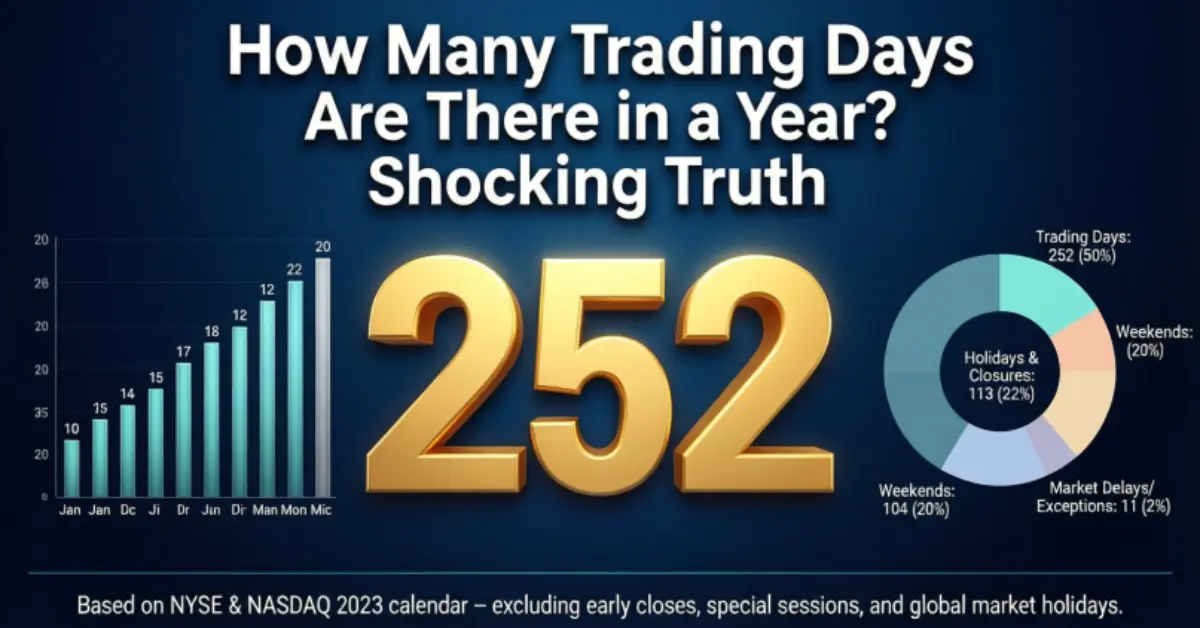
In a typical year, there are around 252 trading days for U.S. markets like the NYSE and NASDAQ. Here’s how that number comes together:
- Total days in a year: 365
- Weekends (Saturdays and Sundays): About 104 days
- Weekdays left: 261
- Major market holidays: Around 9 days, depending on the year
261 weekdays − 9 holidays ≈ 252 trading days
Some years may have 251 or 253 trading days, depending on how holidays land. For instance, if Christmas or New Year’s Day falls on a weekend, the observed holiday shifts to a Friday or Monday, slightly adjusting the total.
Mini Example: Seeing the Impact
Let’s say you’re tracking your portfolio’s daily growth over a year. If you incorrectly assume there are 260 trading days, your calculations for returns, volatility, or even daily averages could be off. Even a difference of a few days changes projections and strategy outcomes, which is why it’s important to know the exact count.
Global Perspective
It’s worth noting that this number is specific to U.S. markets. Other countries have different holiday schedules and weekend rules. For example, markets in the Middle East often follow a Sunday-to-Thursday workweek, which changes their annual trading days. So if you’re trading international stocks, the “typical” number of trading days may differ.
Understanding the typical range of trading days is more than a statistic-it’s foundational for planning trades, strategies, and market expectations.
May be you like it:
Top 10 Best Trading YouTube Channels to Follow in 2025
Funding an LLC: Easy Ways to Get Startup Money
Family Wealth Strategy – Build and Protect Your Legacy
Invest Wisely: Smart Tips for Growing Your Money
Benefits of Knowing the Exact Number of Trading Days
You might wonder, “Why does it even matter to know exactly how many trading days there are in a year?” It turns out, this knowledge can make a real difference-whether you’re a casual investor or a serious trader.
Accurate Performance Tracking
When calculating annual returns, volatility, or growth rates, knowing the exact number of trading days ensures your numbers are precise. Imagine estimating your portfolio’s growth assuming 260 trading days, when in reality there are only 252. That small mismatch can subtly skew your projections, especially over multiple years.
Better Strategy Planning
Traders who rely on daily patterns-like momentum or swing strategies-need to account for every available trading day. Missing a few days due to holiday miscalculations could throw off entry and exit timing. By understanding the real number of trading days, you can plan trades more effectively and avoid surprises.
Realistic Goal Setting
If your goal is to make a certain number of trades or achieve a specific return within a year, knowing the exact number of trading days lets you set achievable, realistic targets. It prevents overestimating opportunities and helps maintain discipline in your strategy.
Risk Management
Fewer trading days mean fewer opportunities to react to market changes. Understanding the schedule helps with risk assessment, ensuring you don’t overexpose your portfolio during holidays or market closures.
Mini Example: Putting It Into Practice
Say you’re testing a trading algorithm that buys and sells every day. If you forget that there are only 252 days, your system might expect more price data than actually exists. Knowing the correct number lets you align your model with real-world conditions, improving accuracy and reliability.
Drawbacks and Limitations: Why Trading Days Can Vary Each Year
While knowing the typical number of trading days is useful, it’s also important to understand why that number isn’t set in stone. The exact count of trading days can fluctuate, and these variations can affect planning, strategy, and expectations.
Shifting Holidays
One of the main reasons trading days vary is how holidays fall on the calendar. If New Year’s Day, Christmas, or Independence Day lands on a weekend, the observed holiday shifts to a nearby weekday. Some years this adds or subtracts a day from the total trading days, which can subtly affect trading plans and backtesting results.
Unplanned Market Closures
Although rare, stock exchanges sometimes close unexpectedly due to extreme weather, technical failures, or national events. For example, a snowstorm might shut down the NYSE for a day, or there might be a technical glitch preventing trades. These unplanned closures are exceptions, but they highlight that the market isn’t 100% predictable.
Regional Differences
If you trade international markets, the number of trading days can vary widely. Markets in Asia, Europe, and the Middle East follow different holiday calendars and workweeks. Even if you know the U.S. schedule perfectly, it won’t necessarily match the trading days of other countries.
Impact on Strategy and Planning
Variations in trading days mean that traders and investors need to stay flexible. Strategies based on a fixed number of trading days may need adjustment when holidays or closures change the available trading opportunities. Rigid assumptions can lead to missed trades, inaccurate performance tracking, or misaligned risk management.
Mini Insight
Think of trading days like the tides for a sailor. You can plan your journey, but occasional shifts and unexpected events can change conditions. By recognizing the variability in trading days, you’re better equipped to adapt and stay on course, rather than being caught off guard.
Real-World Applications: How Traders and Investors Use Trading Day Data

Understanding how many trading days are there in a year isn’t just theoretical-it has practical applications that can directly affect your decisions, strategies, and overall success in the market.
Planning Trading Strategies
Traders who rely on daily patterns, swing trades, or momentum strategies need to know the exact number of trading days. This helps them schedule entries and exits realistically, avoid overtrading, and accurately backtest their strategies. For example, a trader who wants to execute 200 trades in a year can plan properly knowing there are roughly 252 trading days.
Portfolio Performance Analysis
Investors who track annual returns often calculate metrics like average daily gains or volatility per trading day. Without knowing the true number of trading days, these calculations can be slightly off, potentially leading to misleading conclusions about portfolio performance.
Risk Management and Allocation
Knowing when markets are closed helps investors and traders manage exposure and plan risk. For instance, if a major holiday is coming, you might anticipate lower liquidity or adjust stop-loss orders to avoid being caught in unexpected gaps when the market reopens.
Algorithmic Trading and Automation
Automated trading systems and bots rely on accurate trading calendars to function correctly. Missing a few trading days in the system can throw off signals, backtesting data, and expected returns. Professionals always account for holidays, weekends, and even rare market closures to ensure algorithms operate reliably.
International Trading Considerations
For investors trading global markets, understanding trading days in each region is crucial. Markets in Europe, Asia, and the Middle East have different holidays and working weeks, so being aware of these differences helps coordinate trades and avoid missed opportunities.
Mini Example: Real-Life Insight
Imagine you’re tracking a stock that tends to move strongly on Mondays. If a holiday shifts the schedule, that “Monday effect” could occur on a Tuesday instead. Traders who account for trading days can adapt their strategies, while those who don’t may misread patterns or miss opportunities.
May be you like it:
Top Finance Webinars to Boost Your Money Skills
My Funding Choice: Find the Best Way to Finance Your Goals
Wealth and Success – Habits That Transform Your Future
Invest Criteria: How to Choose Smart Investments
Factors That Affect Trading Days: Holidays, Weekends, and Special Closures
When trying to answer how many trading days are there in a year, it’s not enough to just subtract weekends and holidays from the calendar. Several factors influence the total number of trading days, and understanding them can give you a clearer picture of market behavior and planning.
Weekends
The most obvious factor is that stock markets are closed on Saturdays and Sundays. This is consistent across most exchanges worldwide, including the NYSE and NASDAQ. Even if you’re eager to trade or check prices, weekends simply don’t count as trading days.
Market Holidays
Exchanges observe specific holidays, and these can vary slightly depending on the year. In the U.S., common market holidays include:
- New Year’s Day
- Martin Luther King Jr. Day
- Presidents’ Day
- Good Friday
- Memorial Day
- Juneteenth
- Independence Day
- Labor Day
- Thanksgiving
- Christmas
Some of these holidays occasionally fall on weekends, in which case the market observes the holiday on a nearby weekday, slightly shifting the annual trading day count.
Special or Unexpected Closures
Beyond regular holidays, exchanges can close unexpectedly for unusual events:
- Extreme weather events (e.g., snowstorms, hurricanes)
- Technical glitches or outages affecting trading systems
- National emergencies or unforeseen circumstances
While these closures are rare, they highlight that trading days aren’t entirely predictable, and traders must remain adaptable.
Mini Insight: Why These Factors Matter
Consider an investor planning to execute a strategy every trading day. If they overlook that a few weekdays are holidays or unexpected closures, their timing, risk management, and performance calculations could be off. Even seasoned traders often double-check the official trading calendar each year to avoid surprises.
In short, the combination of weekends, holidays, and occasional special closures is what determines the real number of trading days in any given year, and being aware of these factors is key to smart market participation.
Comparing Different Markets: U.S. vs. Global Trading Calendars

If you’re wondering how many trading days are there in a year, it’s important to remember that this number isn’t universal. While U.S. markets like the NYSE and NASDAQ generally have about 252 trading days, international markets follow different calendars, holidays, and workweeks. Understanding these differences can be crucial for global investors and traders.
U.S. Markets
As we’ve discussed, U.S. exchanges are open Monday through Friday, excluding about nine major holidays. This schedule gives roughly 252 trading days per year. It’s a system many traders use as a baseline, but it only applies if you’re trading domestic stocks or U.S.-listed ETFs.
European Markets
European exchanges, such as the London Stock Exchange (LSE) or Euronext, also follow Monday-to-Friday trading. However, the holidays are different. For example:
- Good Friday and Easter Monday are observed in Europe, unlike in some other regions.
- Many countries observe local public holidays, like Bastille Day in France or St. Stephen’s Day in Austria.
These variations slightly reduce the number of trading days compared to the U.S., often ranging between 250–253 days depending on the country and year.
Asian Markets
Asian markets like the Tokyo Stock Exchange (TSE) or Hong Kong Stock Exchange (HKEX) also operate Monday through Friday, but they have their own set of holidays:
- Japan observes Golden Week holidays, which can last several days.
- Hong Kong has local holidays like Lunar New Year and National Day.
Depending on the year, these exchanges may have fewer or more trading days than the U.S. market, which affects global trading strategies.
Mini Insight: Why It Matters
If you’re trading across multiple markets, assuming the same number of trading days everywhere can lead to misaligned strategies and missed opportunities. For example, a European trader might expect 252 days like in the U.S., but a local holiday could mean fewer trading days, affecting portfolio adjustments or algorithmic trading schedules.
Key Takeaway
Global markets are not synchronized in terms of trading days. Knowing the exact trading calendar for each market you operate in ensures accurate planning, risk management, and performance tracking, especially if you’re trading internationally.
Frequently Asked Questions
Q: How many trading days are there in a year?
A: Typically around 252 for U.S. markets, depending on holidays.
Q: Do weekends count as trading days?
A: No, markets are closed on Saturdays and Sundays.
Q: Why does the number of trading days vary each year?
A: Holidays, weekend shifts, and rare closures can change the total.
Q: Do pre-market or after-hours trades count?
A: No, only official market hours count as trading days.
Q: Are trading days the same in global markets?
A: No, each country has its own holidays and workweek schedule.
Conclusion:
So, how many trading days are there in a year? For U.S. markets like the NYSE and NASDAQ, the answer is usually around 252 days, give or take a day depending on holidays and occasional closures. While that number might seem like a simple statistic, understanding it has real implications for anyone serious about trading or investing.
Key Takeaways:
- Trading days aren’t all weekdays: Weekends and market holidays reduce the total number of available trading days.
- Variations happen: Shifting holidays, unplanned closures, and global market differences can slightly change the count each year.
- Practical value: Knowing the exact number of trading days helps with performance tracking, risk management, realistic goal setting, and strategy planning.
- Global perspective matters: If you trade internationally, each market has its own calendar, and ignoring this can lead to misaligned trades or missed opportunities.
Planning Your Trading Year
By keeping track of trading days, you can align your strategies with reality instead of assumptions. Whether you’re calculating potential returns, testing algorithms, or setting trading goals, having a clear calendar ensures your decisions are well-informed and realistic.
May be you like it:
Best Day Trading Setup – Simple Strategies That Work
Business Finance Definition Made Easy for Understanding Info
