

Introduction:
Let’s be real-choosing a degree in finance isn’t just about picking a subject from a list. It’s about shaping the career you’ll spend years building, and yes, it can directly impact how much you earn down the line. The best degrees in finance don’t just teach theory-they open doors to roles that pay well, offer growth, and give you options in a competitive industry.
Think about it this way: two graduates can both have finance-related degrees, but one ends up in a role with a clear salary path, promotions, and real-world exposure, while the other struggles in a job that doesn’t match their skill set. The difference often starts with the degree itself.
In this guide, we’ll break down which finance degrees are worth considering, why they matter for high-paying careers, and how to align your choice with your long-term goals-so you’re not just studying for the sake of a diploma, but investing in your future.
Table of Contents
Understanding High-Paying Roles in Finance
When people think of finance careers, the first images that pop up are usually bankers in suits or stock traders in bustling offices. But the field is far broader-and the opportunities for high-paying roles are more diverse than most realize. From traditional banking to investment management, corporate finance, and the booming world of fintech, each path comes with its own earning potential and skill requirements.
Banking
Banking roles-like investment banking analysts or commercial bankers-often come with strong starting salaries, but the workload can be intense. Long hours are common, but for many, the experience and networking opportunities in top banks set the foundation for future high-paying roles.
Investment Management
This includes portfolio managers, hedge fund analysts, and asset management professionals. These positions often offer performance-based bonuses that can dramatically increase total compensation. Success here depends not just on a degree, but on analytical skills, market intuition, and experience.
Corporate Finance
Corporate finance professionals handle budgeting, financial planning, and strategy within companies. While salaries might start lower than investment banking, these roles often grow steadily, offering leadership paths that can rival traditional finance sectors in earning potential.
Fintech
Fintech is the fastest-growing segment, blending finance with technology. Roles like product finance managers, digital payment specialists, or blockchain analysts are increasingly in demand-and they often come with competitive pay because the combination of financial knowledge and tech skills is rare.
Here’s the crucial insight: your degree alone doesn’t dictate how much you’ll earn. Two people with the same finance degree can have vastly different paychecks depending on their skills, experience, internships, networking, and how effectively they apply what they’ve learned. That’s why choosing the right degree is just the first step-it’s about pairing education with practical experience and targeted skill-building.
Bachelor’s Degree in Finance
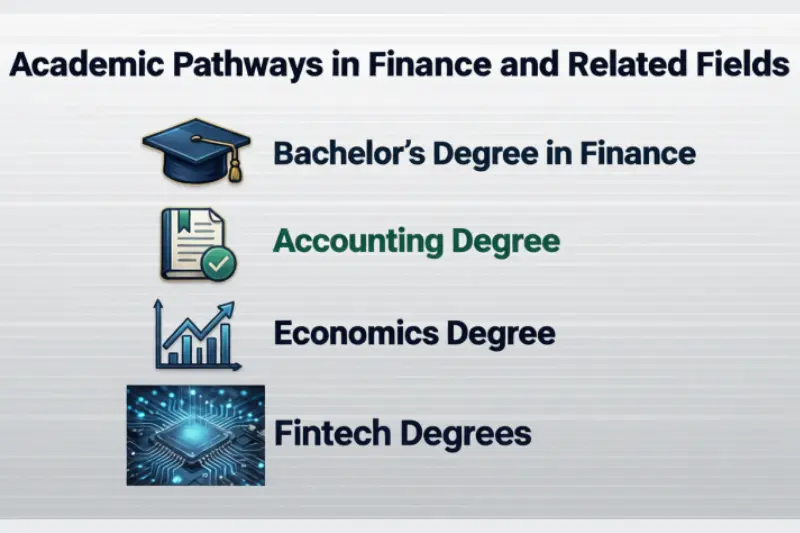
A Bachelor’s degree in Finance is often the go-to starting point for anyone serious about a career in money management, investments, or corporate finance. It’s the foundation that teaches you how financial systems work in real life, not just on paper.
Core Subjects You’ll Cover
Most programs give you a solid mix of theory and practical skills, including:
- Financial Analysis: Learning to interpret financial statements and assess company performance
- Corporate Finance: Understanding how businesses raise capital, invest, and manage risk
- Investments and Portfolio Management: Basics of stocks, bonds, and other asset classes
- Risk Management: Identifying, analyzing, and mitigating financial risks
Many programs also include real-world case studies or internships, which are crucial for turning academic knowledge into actionable skills.
Career Opportunities and Potential Salary Ranges
Graduates can step into roles like:
- Financial Analyst: Typically starts around $60k–$70k/year in the U.S., with rapid growth if you gain experience
- Investment Banking Associate: Can start $85k–$100k/year plus performance bonuses
- Corporate Finance Specialist: Often starts $65k–$75k/year, with potential for management track growth
- Financial Planner or Advisor: Entry-level can be lower, but commissions and client portfolios can significantly increase earnings
The real takeaway? A Bachelor’s in Finance is versatile-it positions you for multiple high-paying paths, but your ultimate income depends on your skills, experience, and networking.
Who It’s Ideal For
This degree works best if you:
- Want a direct, practical path into finance
- Like numbers but also strategic thinking
- Are open to various finance sectors and don’t want to specialize too early
It’s essentially the degree that gives you options without locking you into one narrow path-and that flexibility is often what leads to higher earnings in the long run.
May be you like it:
How Long Does It Take to Learn Day Trading Effectively?
Boost Your Career with an Online Accounting Diploma
Smart Strategies for Generational Wealth Management
What Is a Smart Investment – Simple Guide for Beginners
Accounting Degree
Accounting often gets a reputation for being “just about numbers,” but anyone who’s spent time in the industry knows it’s much more than that. An Accounting degree gives you a solid foundation for understanding how money moves inside organizations, and that knowledge is highly valued-and well-compensated-across industries.
Practical Skills and Industry Relevance
With this degree, you’ll learn skills that employers practically drool over:
- Financial Reporting: Reading and interpreting complex financial statements
- Auditing: Evaluating accuracy and compliance, which is critical for corporate governance
- Taxation and Regulatory Compliance: Knowing the rules inside and out
- Analytical Thinking: Spotting trends, inefficiencies, or risks before they become problems
These are not just classroom exercises-they’re exactly what companies need to stay profitable and compliant. That’s why accounting grads are in demand across every sector, from banks to tech startups to multinational corporations.
How Accounting Opens High-Paying Roles
Accounting degrees lead to careers with strong earning potential, often with predictable growth:
- Corporate Accountant: Base salaries start around $55k–$65k/year, often rising with experience
- Auditor or Assurance Specialist: $60k–$75k/year, with opportunities to move into consulting or advisory
- Financial Controller or Corporate Finance Manager: Can exceed $100k/year once you gain experience
Many finance leaders actually started in accounting roles because the discipline teaches attention to detail, risk awareness, and a deep understanding of how businesses operate-skills that are invaluable in higher-paying finance positions.
Certifications That Boost Income
While the degree opens doors, professional certifications can significantly increase your earning potential:
- CPA (Certified Public Accountant): Often required for top accounting and corporate finance roles
- CMA (Certified Management Accountant): Focuses on strategy, planning, and management accounting
- Chartered Accountant (CA) / ACCA: Especially valuable for global career opportunities
Adding a certification shows employers that you not only understand accounting theory but can also apply it at a professional level-often translating into higher salaries and faster career progression.
In short: If you like precision, structure, and knowing exactly how businesses function financially, an Accounting degree is a powerful launchpad for high-paying roles-and it gives you skills that stay relevant no matter how the economy changes.
Economics Degree
An Economics degree might not scream “finance career” at first, but it’s actually one of the most versatile paths into high-paying roles. Unlike degrees focused purely on numbers or accounting, economics trains you to see the big picture-how markets behave, how policies influence industries, and how financial trends ripple across the globe.
Big-Picture Analytical Skills
Economics graduates develop critical thinking that goes beyond spreadsheets:
- Market Analysis: Understanding supply, demand, and pricing trends
- Data Interpretation: Spotting patterns in economic indicators and financial statistics
- Strategic Thinking: Anticipating how decisions at the macro level affect companies or portfolios
- Problem-Solving: Using logic and evidence to make recommendations that matter
These skills are highly prized in finance because companies aren’t just looking for someone to crunch numbers-they need people who can forecast, strategize, and make informed decisions.
Roles Economics Graduates Take in Finance
Graduates often move into roles that bridge theory and practice, such as:
- Financial Analyst or Strategy Analyst: Using economic trends to guide corporate investments
- Investment Banking Associate: Leveraging market insights to advise clients
- Consulting or Advisory Roles: Helping organizations make data-driven financial decisions
- Risk Analyst or Policy Advisor: Evaluating economic conditions to inform risk and compliance
Pairing an Economics degree with internships, certifications, or technical skills (like Excel, SQL, or data visualization) makes graduates highly competitive for top-paying positions.
Why It Can Lead to High-Paying Careers
Economics graduates are valued because they combine analytical thinking with a broad understanding of markets. This makes them adaptable-able to pivot between corporate finance, consulting, investment, or even fintech-and adaptability in finance often translates to higher salaries.
In short, if you enjoy asking why things happen, seeing patterns before others do, and using logic to make decisions that impact money on a large scale, an Economics degree is a strong foundation for a rewarding, high-paying finance career.
Fintech Degrees
Finance isn’t what it used to be. With technology reshaping how money moves, Fintech degrees have emerged as one of the fastest-growing paths into high-paying finance careers. These programs combine traditional finance knowledge with tech skills, preparing graduates for roles that didn’t exist a decade ago.
The Rise of Tech-Driven Finance Jobs
From digital banking and payment platforms to blockchain and automated investment tools, fintech has created entirely new career paths. Companies are willing to pay a premium for graduates who understand both the financial side and the technology behind it. Roles like product finance manager, blockchain analyst, or digital payments specialist are not only exciting but also financially rewarding because the skill set is rare and in demand.
Skills Learned and Why Companies Pay Well
A fintech degree equips you with:
- Financial Literacy: The foundational concepts of finance and investment
- Technology Skills: Basics of coding, data analytics, or blockchain systems
- Problem-Solving: Designing or improving financial technology solutions
Product Management & Strategy: Understanding how tech products generate revenue
Employers pay well because these graduates can bridge the gap between finance and technology, turning complex systems into profitable solutions. That combination is rare-and highly valued.
Best-Suited Candidates
Fintech degrees aren’t for everyone. They work best if you:
- Enjoy both finance and technology
- Like solving complex, real-world problems
- Are comfortable with continuous learning, since tech evolves rapidly
- Want career flexibility across finance, tech, and startups
If you fit this profile, a fintech degree can open doors to high-paying, cutting-edge roles in an industry that’s only going to grow.
Business Administration (Finance Focus)
A Business Administration degree with a finance focus is perfect for those who want to combine financial knowledge with leadership skills. Unlike a traditional finance or accounting degree, it doesn’t just teach numbers-it shows you how businesses operate as a whole and prepares you to make strategic decisions that impact the bottom line.
Leadership and Management Opportunities
This degree often emphasizes management, strategy, and decision-making, which means graduates are well-positioned for leadership roles. Whether it’s managing a finance team, overseeing budgets, or contributing to corporate strategy, the skills gained here make you a candidate for positions that come with both responsibility and higher pay.
Flexibility for Diverse Finance Roles
One of the biggest advantages is versatility. Graduates can step into:
Corporate finance or treasury roles
- Financial planning and analysis
- Business consulting
- Operations or project management roles with a financial focus
Because the degree blends business and finance, you’re not locked into a single path-you can pivot between industries and roles, which often leads to better long-term earning potential.
How It Impacts Earning Potential
Leadership roles tend to pay more, and this degree sets you up for exactly that. Even entry-level positions may start slightly higher than traditional finance roles because employers recognize the combination of financial acumen and business strategy. Over time, promotions and managerial responsibilities can substantially increase your income.
In short: If your goal is a career where you make strategic decisions, lead teams, and have flexibility across finance roles, a Business Administration degree with a finance focus can be a smart investment that pays off in both career satisfaction and salary.
MBA in Finance
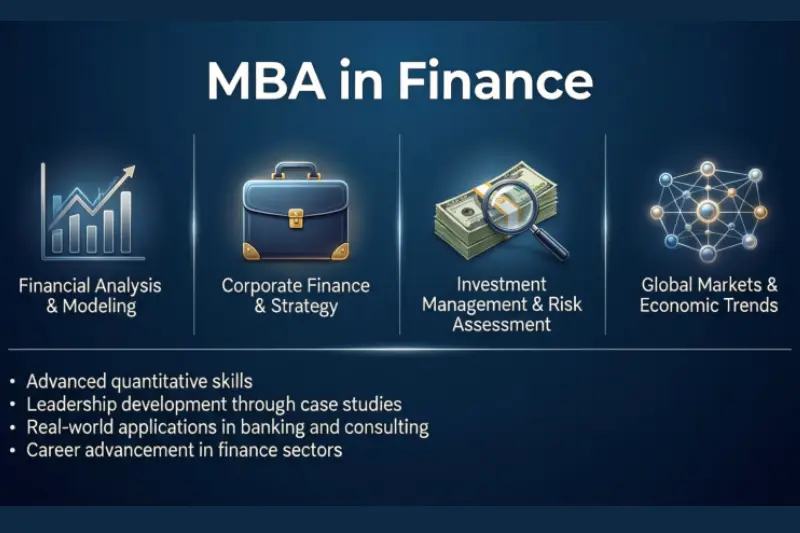
An MBA in Finance is often viewed as a fast track to high-paying leadership roles-but here’s the catch: timing and experience matter more than the degree itself. Unlike undergraduate programs, an MBA isn’t just about learning concepts; it’s about leveraging your work experience to move up the career ladder.
Why Timing and Experience Matter
An MBA works best if you already have a few years of professional experience. Employers value candidates who can combine academic knowledge with real-world insight. Jumping straight into an MBA without hands-on finance exposure can limit your ROI, because the degree alone won’t give you the perspective companies pay top dollar for.
Career Acceleration and High-Paying Leadership Roles
Graduates with an MBA in Finance often step into positions like:
- Finance Director or VP of Finance
- Investment Banking Manager
- Corporate Strategy Leader
- Senior Financial Analyst in multinational firms
These roles typically offer six-figure salaries, performance bonuses, and rapid advancement opportunities. The degree signals to employers that you’re capable of strategic thinking, decision-making, and managing teams, which are precisely the skills that command higher pay.
ROI Considerations
MBAs can be expensive, both in tuition and opportunity cost, so it’s important to weigh the investment against potential outcomes. The best return comes when:
- You choose programs with strong industry connections
- You apply your work experience to your studies
- You target careers that value leadership and strategic finance knowledge
In short, an MBA in Finance is a high-value tool-but it’s most effective when combined with experience, clear career goals, and a strategic approach to post-graduation opportunities.
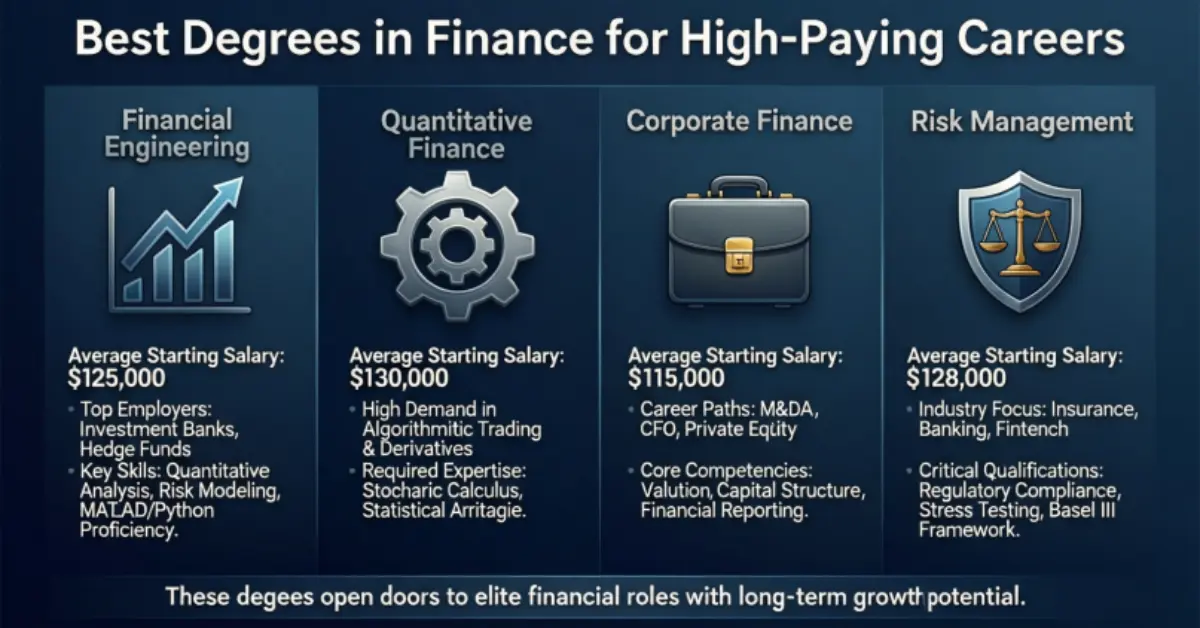
Specialized Finance Degrees: Financial Engineering, Investment Management, Risk Management
For finance professionals who know exactly what they want, specialized degrees can be a direct route to high-paying roles. These programs focus on niche skills that aren’t always covered in traditional finance or economics degrees-making graduates highly valuable to certain employers.
Niche Skills That Drive High Salaries
Each specialized path builds expertise that companies are willing to pay a premium for:
- Financial Engineering: Heavy on mathematics, modeling, and quantitative analysis. Ideal for algorithmic trading, derivatives analysis, and quantitative finance roles.
- Investment Management: Focuses on portfolio management, asset allocation, and wealth advisory. Graduates often step into high-paying roles managing large funds or client portfolios.
- Risk Management: Teaches how to identify, evaluate, and mitigate financial risks. Companies in banking, insurance, and corporate finance pay well for professionals who can protect assets and ensure compliance.
These degrees equip you with skills that are rare and highly specialized, which is why the compensation can be significantly higher than more general finance roles.
When to Choose a Specialized Degree vs. a General Degree
Specialized degrees aren’t for everyone. Consider them if:
- You’re already certain about the niche you want to work in
- You’re prepared to commit to an intensive, technical curriculum
- You’re aiming for roles where expertise is highly valued and compensated
If you’re still exploring your career path, a general finance degree may be a safer choice-it provides flexibility while you discover where your strengths and interests lie. Once you identify your niche, you can always supplement your education with certifications or graduate-level specialization.
In short: Specialized finance degrees can fast-track you into high-paying roles, but they work best when paired with clear career goals and a focus on real-world application.
Key Skills That Boost Salary Across All Finance Degrees
A degree is just the starting point. In the real world, your earning potential often depends more on the skills you bring to the table than the diploma hanging on your wall. Whether you choose a Bachelor’s in Finance, Accounting, Economics, or a specialized degree, certain skills consistently help graduates land higher-paying roles.
Technical Skills
Finance is still a numbers game, and technical proficiency is non-negotiable. The most in-demand skills include:
- Excel & Financial Modeling: Building projections, analyzing cash flow, and creating decision-making tools for managers
- Data Analysis: Interpreting datasets to identify trends, forecast performance, or assess risk
- Software Knowledge: Familiarity with accounting platforms, ERP systems, or financial databases
Mastering these tools doesn’t just make you competent-it makes you indispensable, and companies reward that.
Soft Skills
Numbers alone won’t get you far. Employers are increasingly paying premiums for finance professionals who can:
- Communicate Clearly: Present findings to executives, clients, or teams in a way that’s easy to understand
- Solve Problems Strategically: Turn data into actionable insights and solutions
- Understand Business Context: See the bigger picture-how financial decisions impact operations, strategy, and growth
These soft skills often distinguish high earners from their peers, especially in leadership, advisory, or client-facing roles.
How These Skills Amplify the Value of Any Finance Degree
Think of your degree as a key that opens the door. Skills are what make the company hand you the corner office-or at least a higher paycheck. For example:
- A financial analyst with excellent modeling skills may be fast-tracked to senior analyst roles
- An accountant who can clearly explain findings to non-finance teams can land management positions sooner
- A fintech graduate who combines tech knowledge with business understanding may negotiate higher salaries right out of school
In short, pairing a finance degree with the right mix of technical and soft skills multiplies your value to employers-and that’s the real driver behind high-paying careers.
May be you like it:
Free Trading Webinar: Learn Smart Market Strategies
Certificate in Business Management Online: Your Career Boost
Smart Generational Wealth Planning for Lasting Legacy
Top Personal Investment Company Tips for Smart Investors
FAQs
What are the best degrees in finance?
Finance, Accounting, Economics, Fintech, and specialized programs like Financial Engineering are top choices.
Which finance degree pays the most?
MBAs in Finance, Investment Management, and Financial Engineering often lead to the highest salaries.
Is a Bachelor’s in Finance worth it?
Yes, it opens doors to analyst, corporate finance, and investment roles with strong earning potential.
Can an Economics degree lead to a finance career?
Absolutely. Economics grads excel in analysis, consulting, and investment roles that pay well.
What skills boost finance salaries?
Excel, financial modeling, data analysis, communication, problem-solving, and business understanding.
Should I choose a specialized finance degree?
Only if you know your niche—like risk management, investment management, or quantitative finance.
Is an MBA in Finance necessary for high-paying jobs?
Not always, but it’s valuable for leadership roles and higher-level strategic positions.
What is the fastest-growing finance field?
Fintech is rapidly expanding, combining finance with technology for innovative, well-paying roles.
Does accounting lead to high salaries?
Yes. With certifications like CPA or CMA, accountants can secure leadership and executive finance positions.
How do I choose the best finance degree for me?
Consider your career goals, personality, skills, and whether you want flexibility or a specialized path.
Conclusion
Choosing the best degrees in finance isn’t just about prestige or the name on your diploma-it’s about aligning your education with your career goals, skills, and the kind of work that excites you. Every degree we discussed-from Finance and Accounting to Economics, Fintech, and specialized programs-can lead to high-paying careers if paired with the right experience and practical skills.
The key takeaway? Your degree opens doors, but your skills, decisions, and real-world experience determine how far you go. Whether you aim to lead a finance team, manage investments, or innovate in fintech, making thoughtful choices early will pay off later-literally and professionally.
So, take the time to understand your strengths, explore your interests, and invest in both your knowledge and capabilities. In finance, the combination of the right degree and the right skill set is what truly drives success—and the rewarding career you’re aiming for.
May be you like it:
Stock Market for Beginners PDF – Your Simple Starter Guide
Top MBA Certificate Programs Online for Career Growth
