

Introduction
Money makes the world go round-but not all money knowledge is created equal. Have you ever heard someone say, “I studied finance, so I know how to run my business,” only to see them struggle with cash flow or daily expenses? That’s because finance and business finance aren’t the same thing.
Confusing the two isn’t just a technical mistake-it can lead to real problems. A business might look profitable on paper yet fail because of poor cash timing. Professionals might make decisions that work in theory but flop in practice. Understanding the difference isn’t just academic; it’s practical, career-shaping, and even life-saving for your business.
By the end of this article, you’ll know why distinguishing business finance vs finance matters, and how that knowledge can make money decisions easier, smarter, and less stressful.
Table of Contents
What Is Finance?
When most people hear the word finance, they think it’s all about managing money. And yes, that’s true-but it’s much broader than just balancing a checkbook or filing taxes. Finance is the study of how money is created, managed, invested, and protected, whether it’s for individuals, companies, or entire governments.
Finance can be broken down into three main areas:
Personal Finance
This is the money side of everyday life. It includes budgeting, saving, investing, paying off debt, and planning for the future. Anytime you check if you can afford a vacation or plan for retirement, you’re dealing with personal finance. It’s practical and directly affects your life, but it’s just one slice of the finance world.
Public Finance
This area covers government money. Taxes, national budgets, public spending, and debt management all fall under public finance. When governments make decisions about interest rates, infrastructure spending, or stimulus packages, public finance is the engine behind those moves.
Corporate Finance
Corporate finance focuses on companies and how they handle money strategically. It looks at raising capital, funding investments, mergers, and long-term growth. Corporate finance answers questions like:
- How should this company fund expansion?
- Is this investment worth the risk?
- How can shareholder value be maximized?
Together, these areas make up the broad field of finance, giving us the rules, tools, and frameworks for understanding money in all its forms.
What Is Business Finance?
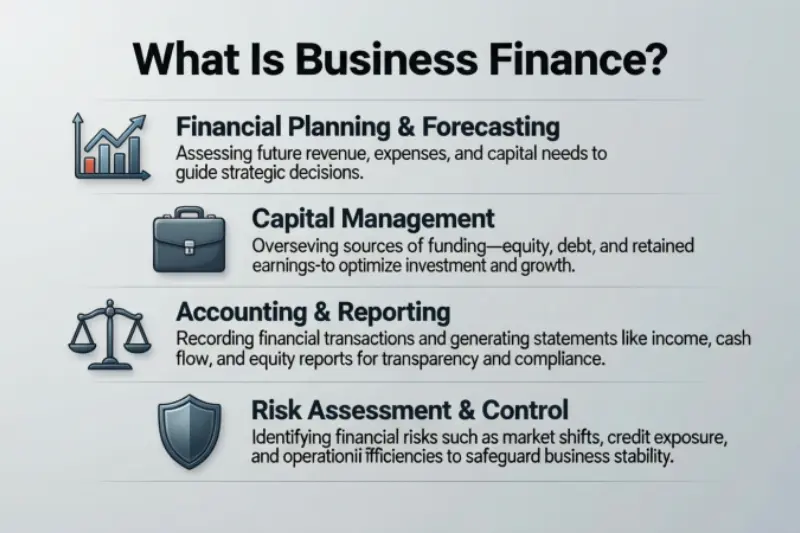
If finance is the big picture of how money works, business finance is the close-up lens that zooms in on a company’s daily and strategic money decisions. It’s less about theory and more about making sure a business runs smoothly and grows sustainably.
Business finance focuses on practical questions that every business faces, such as:
- How much cash do we need to pay suppliers and employees?
- Should we take a loan or bring in investors?
- Can we afford to expand this quarter?
- How do we plan for slow months without running into trouble?
In short, business finance is all about keeping a company financially healthy. It tracks cash flow, manages operating costs, plans budgets, evaluates funding options, and mitigates financial risks. Unlike broad finance, which studies patterns and systems, business finance lives in the real world, where decisions have immediate consequences.
Think of it this way: finance gives you the rulebook for money, but business finance teaches you how to play the game without going broke.
May be you like it:
Top 10 Best Trading YouTube Channels to Follow in 2025
Funding an LLC: Easy Ways to Get Startup Money
Family Wealth Strategy – Build and Protect Your Legacy
Invest Wisely: Smart Tips for Growing Your Money
Core Difference: Scope and Purpose
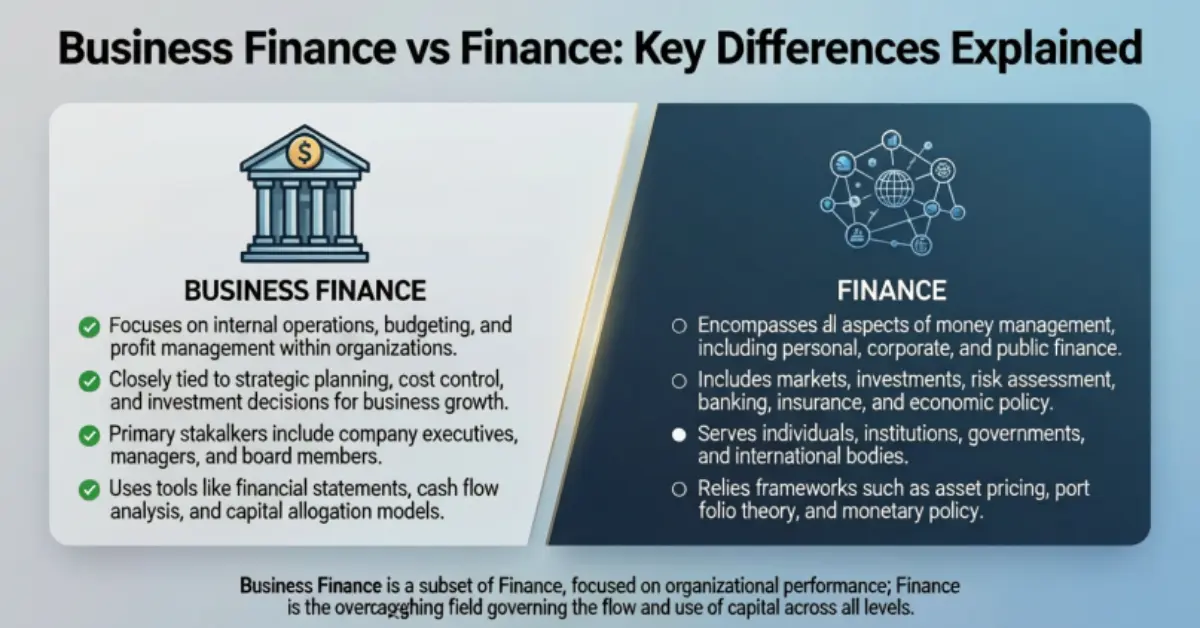
Understanding the difference between business finance vs finance comes down to scope and application.
Finance is broad. It studies money in all its forms-how it moves, grows, and gets managed across individuals, governments, and corporations. It’s about patterns, strategies, and long-term planning. A finance professional might spend weeks analyzing market trends, interest rates, or investment opportunities-often without touching a single day-to-day business decision.
Business finance, on the other hand, is all about action. It applies the principles of finance directly inside a company, helping business owners and managers make decisions that impact cash flow, budgets, funding, and growth. It’s hands-on, practical, and immediate.
Think of it like this: finance gives you the map of the city, showing streets, routes, and landmarks. Business finance puts you in the driver’s seat, deciding which streets to take to reach your destination without running out of fuel.
This distinction is crucial. Confusing the two can lead to decisions that look smart on paper but fail in practice-like investing in growth without checking if you have enough cash to cover next month’s expenses.
Real-Life Examples
Sometimes the difference between business finance vs finance is easiest to see in real-world scenarios.
Imagine a small online store. Sales are steadily increasing, and on paper, the business is making a healthy profit. A finance graduate might look at the spreadsheets and confidently say, “Everything looks great!”
But the owner is stressed. Rent is due next week, suppliers need payment, and a big marketing campaign is coming up. Despite the “profit,” the timing of cash inflows and outflows creates a real problem. This is where business finance comes in-tracking cash flow, prioritizing payments, and planning for short-term funding needs.
Here’s another example:
A startup secures an investment and appears financially strong. A corporate finance analyst might focus on long-term growth projections, ROI, or valuation models. Meanwhile, the founder faces a day-to-day challenge: should they hire a new employee now or wait until next month to avoid running out of cash?
These examples show that finance gives the strategy, but business finance handles the execution. Without applying finance practically, even profitable businesses can struggle-or fail.
Key Areas of Business Finance
Business finance isn’t just about numbers on a spreadsheet. It’s about preparedness Here are the key areas every business needs to focus on:
Cash Flow Management
Cash is the lifeblood of any business. You can show a profit on paper and still struggle if money isn’t available when bills are due. Business finance tracks when money comes in and goes out, helping avoid dangerous shortfalls.
Ask yourself: If three major clients delayed payment this month, could my business cover payroll and supplier invoices? That’s the kind of question cash flow management answers.
Budgeting and Forecasting
Budgeting isn’t about perfection-it’s about preparedness. Forecasting looks ahead and helps businesses anticipate slow months, rising costs, and unexpected expenses. With good budgets and forecasts, owners make smarter decisions instead of guessing or reacting to emergencies.
Funding and Investment Decisions
Every growth opportunity comes with trade-offs. Should you take a loan, bring in investors, or self-fund expansion? Each choice affects control, risk, and long-term stability. Business finance provides frameworks to evaluate funding options realistically, so businesses don’t commit blindly.
Risk Management
Markets fluctuate, costs rise, and clients sometimes disappear. Business finance helps identify financial risks before they become emergencies, allowing companies to prepare or mitigate problems early. It’s about reducing surprises, not eliminating them entirely.
Where Finance Goes Beyond Business
While business finance focuses on day-to-day operations, finance has a much broader scope. It examines money from a strategic and analytical perspective, often beyond the walls of any single company.
Finance professionals study areas like:
- Stock markets – understanding trends, pricing, and investment opportunities
- Interest rates – how borrowing costs affect individuals, businesses, and economies
- Economic cycles – predicting booms, recessions, and market shifts
- Investment theory – evaluating risk, return, and portfolio strategies
The difference is in focus. Finance is about analysis, patterns, and planning, often at a macro level. Business finance is about action and execution, solving real problems like paying employees, funding growth, and managing cash flow.
Think of it this way: finance tells you where the opportunities are and how the system works; business finance makes sure your business survives and thrives within that system.
Career Paths and Opportunities

Understanding the difference between business finance vs finance isn’t just academic-it can shape your career choices. Each path has its own focus, responsibilities, and day-to-day experiences.
Careers in Finance
Finance roles often lean toward analysis, strategy, and system-level thinking. Some common positions include:
- Financial Analyst – studying data to make investment or business recommendations
- Investment Banker – helping companies raise capital or navigate mergers
- Investor – managing portfolios and evaluating risk/return
- Economist – analyzing market trends and economic policies
People in these roles usually focus on long-term planning, modeling, and strategy rather than the immediate operational issues a business faces.
Careers in Business Finance
Business finance careers are more hands-on, focused on keeping a company financially healthy and supporting its growth. Typical roles include:
- Chief Financial Officer (CFO) – oversees all financial decisions and ensures the company meets its goals
- Finance Manager – manages budgets, forecasts, and daily financial operations
- Startup Finance Advisor – helps new businesses plan funding, cash flow, and growth
These positions deal with practical decisions like payroll, supplier payments, pricing strategies, and investment timing-directly impacting a company’s survival and success.
In short, finance prepares you to analyze and strategize, while business finance prepares you to act and execute. Your career choice depends on whether you enjoy working at the macro level or solving real-world operational problems.
Skills Required for Each
Knowing the difference between business finance vs finance also means understanding the skills needed to succeed in each path. While there’s some overlap, the focus and mindset differ.
Skills for Finance
Finance roles often require:
- Analytical thinking – the ability to interpret complex data and spot trends
- Financial modeling – building projections, valuations, or risk assessments
- Market understanding – knowing how interest rates, economic cycles, and investment trends impact money
These skills are essential for roles like financial analysts, investors, or economists, where strategy and long-term planning are the priority.
Skills for Business Finance
Business finance leans more toward practical, hands-on abilities. Key skills include:
- Practical judgment – making decisions under pressure, often with incomplete information
- Decision-making – balancing growth opportunities with financial stability
- Communication – explaining financial data clearly to non-finance team members
- Cash management – keeping track of timing, liquidity, and short-term obligations
In essence, finance is more about thinking and predicting, while business finance is about acting and managing. Mastering both sets of skills can give you a huge advantage, but knowing which to prioritize depends on your goals.
May be you like it:
Top Finance Webinars to Boost Your Money Skills
My Funding Choice: Find the Best Way to Finance Your Goals
Wealth and Success – Habits That Transform Your Future
Invest Criteria: How to Choose Smart Investments
FAQs
What is the main difference between business finance and finance?
Finance is broad and studies money systems, while business finance focuses on applying money decisions within a company.
Does personal finance fall under business finance?
No, personal finance is about individual money management; business finance is only about companies.
Can a profitable business still fail financially?
Yes, if cash flow isn’t managed properly-profit on paper doesn’t always mean cash in hand.
Is corporate finance the same as business finance?
Not exactly. Corporate finance is strategic and high-level, while business finance is practical and operational.
Why is cash flow management important in business finance?
It ensures the business can pay bills, employees, and suppliers on time, avoiding short-term crises.
What skills are essential for business finance?
Practical judgment, decision-making, communication with teams, and cash management.
What skills are essential for finance?
Analytical thinking, financial modeling, and understanding markets and economic patterns.
Can finance knowledge help in running a business?
Yes, but without practical application through business finance, decisions might fail despite strong analysis.
Which career path focuses more on day-to-day company decisions?
Business finance-roles like CFO or finance manager handle operational financial decisions daily.
Should I learn both finance and business finance?
Ideally, yes. Finance gives the big picture, and business finance teaches how to act on it effectively.
Conclusion
Understanding the difference between business finance vs finance isn’t just a matter of definitions-it changes how you make decisions, run a business, or plan a career.
Finance gives you the big picture, the rules, and the strategies for how money works across markets, economies, and organizations. Business finance puts those rules into action, helping businesses survive, grow, and avoid costly mistakes.
When you know which lens to use, decisions stop feeling confusing. You stop guessing about cash flow, funding, or investments, and start acting with confidence. Whether you’re running a startup, managing a company, or planning a career, understanding this distinction is practical, empowering, and often the difference between success and unnecessary stress.
May be you like it:
Best Day Trading Setup – Simple Strategies That Work
Business Finance Definition Made Easy for Understanding Info
